
International Brands Win US Shoppers with Quality Fulfillment
Radial research reveals opportunities for international brands entering the US market. And it starts with quality fulfillment.
International brands have an opportunity they shouldn’t overlook. US shoppers are increasingly interested in shopping with non-US brands in key categories. But capturing a new market isn’t easy, and international retailers will have to navigate supply chain complexity to remain competitive.
With that in mind, Radial conducted research on key trends and opportunities that can help modern brands enter the US market and win customers. The time could be now for international brands to stake a claim—and establish logistics operations—in the US.
US Shoppers Seek International Brands Across Categories
While US shoppers explore international brands for a variety of products, some categories draw them more often than others. Per Radial’s consumer survey data, 60% of shoppers actively or sometimes seek out international brands for consumer electronics, followed by apparel (59%), footwear (58%), and health and beauty products (56%).
Interestingly, younger generations are most likely to shop with international brands. Nearly 70% of Millennials and Gen Z will actively or sometimes shop for international apparel for example. Older generations are less likely to shop internationally but gravitate to consumer electronics most often.
But international brands still need to answer a key question: What will capture and keep the interest of US customers?
Value and Quality Drive US Shoppers’ Interest in International Brands
To attract and retain loyal American shoppers, international brands must assess the overall quality of the product and shopping experience.
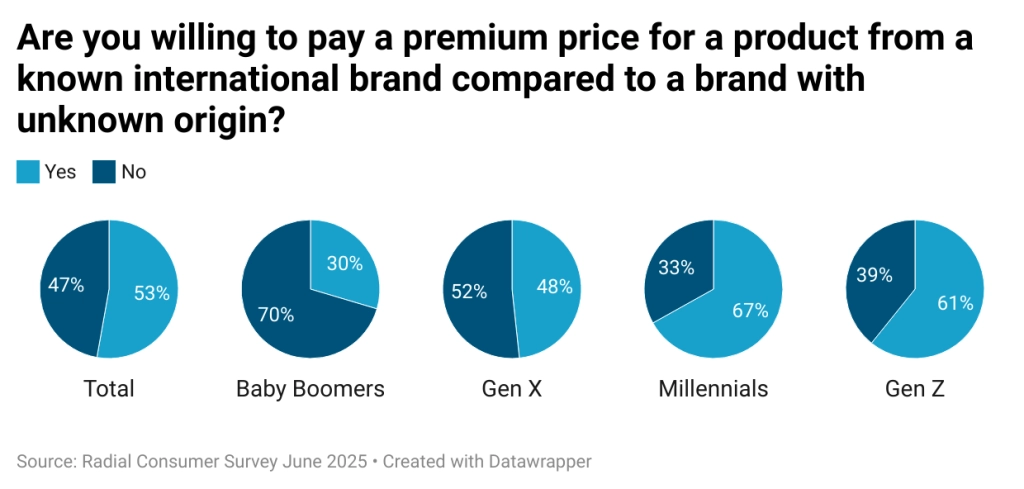
Aside from price considerations, which tend to drive purchase behavior across the board, 49% of consumers purchase international brands due to perceived higher quality products versus domestic brands. And 39% purchase for unique designs or features. In fact, younger consumers are more willing to pay a premium for a known, trusted international brand. Millennials are most likely to pay premiums (67%), followed closely by Gen Z (61%).
Consumers Have Competing Perceptions When Shopping International Brands
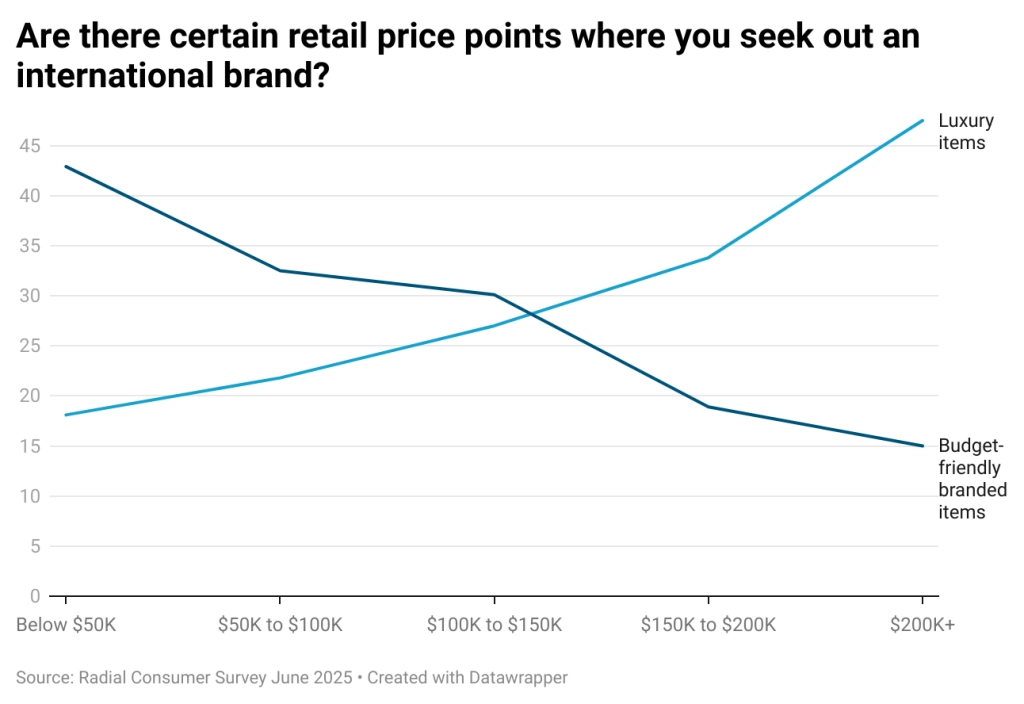
Consumers generally have two competing perceptions of international brands: high-end luxury or budget friendly. These perceptions are split by income, with lower income consumers interested in low prices, while higher income shoppers crave luxuries. Depending on their product portfolios, international brands should assess their pricing strategies in-line with how they want their products to be perceived and valued by shoppers.
The End of De Minimis Creates Turbulence for Some International Brands
The de minimis exemption defines the minimum value threshold under which tariffs and import duties are waived. President Trump signed an executive order in late July 2025 ending the de minimis trade exemption for all packages shipped from other countries.
The end of de minimis signaled headwinds for international brands shipping directly from international origins to US consumers. Many need to reevaluate their fulfillment strategies and potentially pursue a US-based fulfillment strategy to avoid higher duties and taxes, as well as poorer customer experiences. By tackling new fulfillment strategies, they also position themselves to compete more effectively for US customers.
International Brands Focus on High Quality Fulfillment to Meet Consumers’ Expectations
US consumers are not necessarily won over easily, and international brands are competing with national brands for their wallet share. International retailers will need to carefully consider how they communicate quality and balance prices to attract customers.
Per Radial’s research on consumer preferences and expectations for brands, it’s not only the products themselves that drive long-term loyalty. They want great shopping experiences—from the website to order delivery. In fact, quality fulfillment is very important to US consumers. Seventy-two percent of consumers say shipping speed and reliability are the most important factors in deciding whether to buy from modern brands. They also want easy and free returns (63%), more than things like brand identity or product personalization.
Providing great fulfillment in the US presents challenges to international brands if they don’t have local operations set up in-country. They will need to assess the best strategy to enter the new market and evaluate potential fulfillment partners to support expansion.
While importing products to the US may incur tariff costs, US-based fulfillment creates opportunities for international brands to win over US consumers by meeting their high delivery and returns expectations. Additionally, working with logistics partners can allow international brands to leverage complex and resource intensive solutions, like FTZ warehousing.
Radial Fast Track Supports International Brand Expansions into the US and Canada
For many international brands, working with a US-based logistics partner can create long-term success while reducing the risks market expansions often incur. For example, Radial has 40+ years of operational experience and has supported many international brands seeking to enter new markets in the US and Canada.
- Easily expand your brand, grow, and scale: Connect with ease to hundreds of DTC and B2B channel partners quickly and distribute seamlessly from Radial facilities.
- Simple, convenient, pay-as-you-go storage: Pay for what you need with no upfront costs. No long-term contracts required. The ideal solution for brands seeking flexibility as they grow and scale amid supply chain disruptions.
- Leverage operational stability to drive great customer experiences: Radial offers 99.98% order accuracy and 99.84% on-time shipping, which means you and your customers get the stability and consistency necessary to deliver great fulfillment experiences.
- Faster, cost-effective shipping: Simplify delivery with Radial’s transportation and last mile solutions. We work with carriers to find the best balance of speed and cost.
- Ditch returns headaches: Leverage streamlined technology and processes. Make returns, one of the toughest challenges of US fulfillment, easy.
About the author

Get started with fast, cost-effective fulfillment.
