
The Advent of Agentic Commerce May Clash with Consumer Expectations
AI advances promise to transform commerce, but what do consumers think about this new technology? Learn more from Radial’s latest research.
AI advances promise to transform commerce for both brands and shoppers, but what do consumers think about this new technology? Over 63 million US consumers are projected to use AI tools like ChatGPT or AI assistants on retailer websites while they shop in 2026. And while many consumers are curious about agentic commerce, Radial’s research uncovered nuances in how they will respond to, and adopt, AI tools in the future. Importantly, consumers prefer to spend their money with trustworthy brands offering quality products. To create the level of trust and credibility necessary to drive long-term agentic commerce goals, modern brands must first anchor on what customers want most: secure, high quality shopping experiences.
Shoppers Initially Adopt AI for Deal-Finding
Per Radial’s Q1 2026 consumer survey data many consumers start their shopping journey with traditional channels. Only 5% start their search with AI tools. Many begin shopping on search engines (e.g., Google) and marketplaces (e.g., Amazon) where AI tools are now embedded, however.
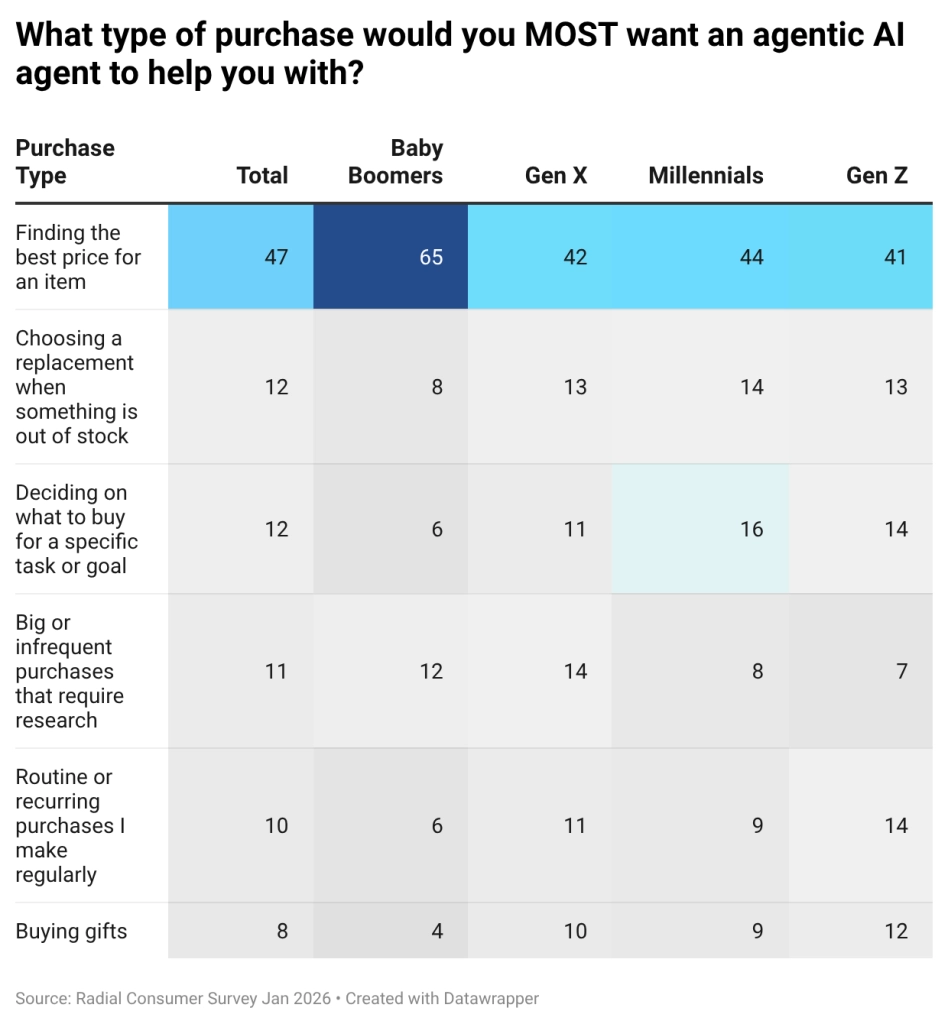
When they do engage with AI, consumers are most interested in agentic commerce when they are certain that they can get maximum value or discover deals. Shoppers want AI to help them find the best prices for a purchase (47%). This far outpaced other use cases; the next highest choice was “choosing a replacement when something is out of stock” at only 12%. These early use cases uncover the current perceptions of how agentic commerce in its nascent form can help consumers find the best prices or in-stock items for something they already know they want.
Shoppers Are Curious About AI, But Hesitate to Embrace It Fully
Before consumers fully engage with agentic AI, they want control and security.
Even when offered time or cost-savings, 34% of consumers would allow an AI to only take approved actions, while 23% want it to make suggestions only. Over one-fifth of shoppers don’t want an AI agent to act on their behalf at all.
With that in mind, brands must earn shoppers’ trust to successfully transition to agentic commerce. While a person may trust a retailer, their store, and their human staff, they may not yet be comfortable trusting an abstract AI agent.
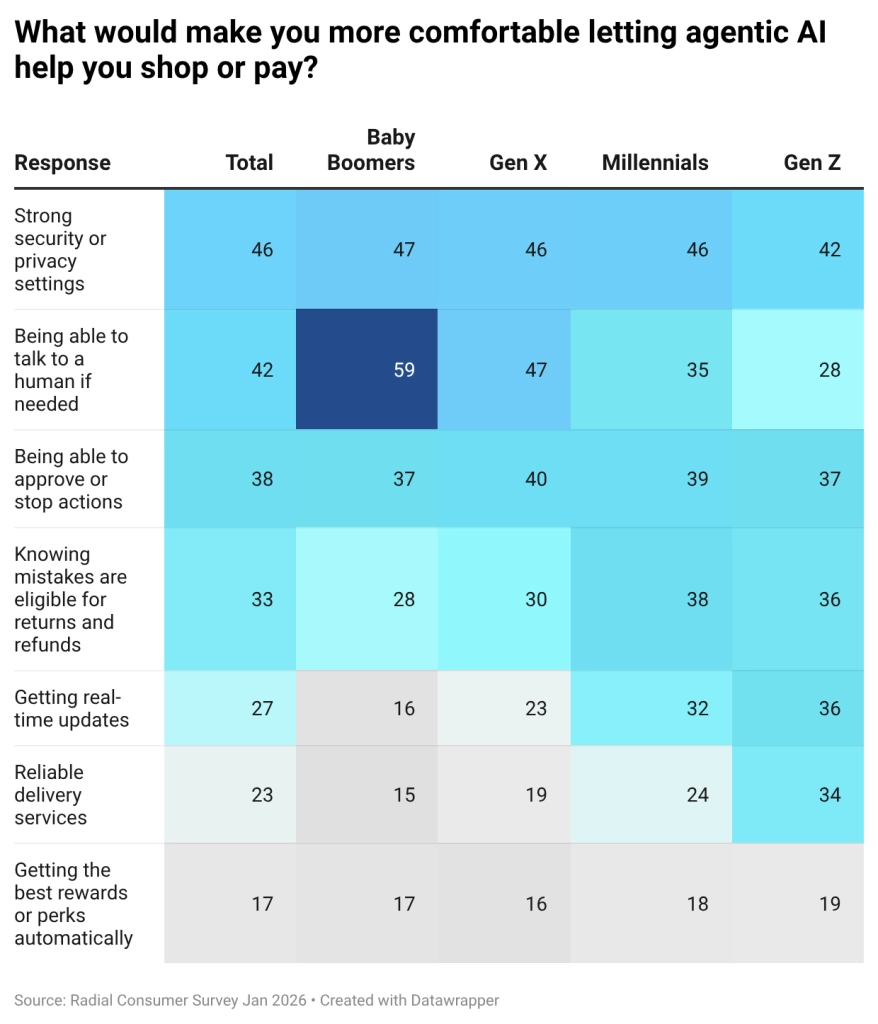
When consumers decide to shop with AI assistance, they expect enhanced security and transparency, backed by the overriding option to speak to a human employee. Nearly half (46%) of consumers will only be comfortable with AI support if there are strong security or privacy settings. And 42% expect to talk to a human if needed.
Retailers Create Trust to Expand AI Adoption
If retailers seek to successfully implement agentic AI as part of their shopping experiences, they will need to first create trust with their customers. As trust grows, shoppers may become more interested in other AI use cases beyond simple, high-control options like deal-finding. For example, while consumers are relatively disinterested in letting AI help make buying decisions today, they may grow increasingly interested as they gain trust in both the brand and its AI tools over time. No matter where retailers implement AI in the buying journey, they will need to foster trust via highly designed, strategic implementations of new technologies.
- Start with security and safety. AI protocols should provide safe, secure, known payment options.
- Establish transparency. Create transparency and accountability for AI tools, both from a regulatory perspective and in the context of a consistent, trustworthy customer experience.
- Adopt a flexible AI approach. Avoid exclusive partnerships with one AI platform or toolset over another. Instead, build a strategy around flexibly integrating with a variety of providers.
- Reinforce AI accuracy. Nearly one-third of shoppers are worried about incomplete or inaccurate information presented by an AI agent. While errors exist within any system, retailers will need to err on the side of accuracy and transparency to reassure customers that their AI tools can manage the shopping experience effectively.
- Foster human control and agency. Shoppers draw the line at losing control and human agency. Brands can most effectively drive AI adoption by providing a sense of control to the consumer, from preference settings to escalation paths involving human representatives.
- Work with experienced technology and payment partners. The right partners can accelerate agentic commerce for modern brands. For example, payment partners can provide a managed payment orchestration (MPO) solution to drive operational simplicity and long-term success.
- Work with expert logistics partners. In order to effectively leverage agentic commerce as a competitive advantage, modern brands will need to ensure they have flexible, technology-driven logistics solutions to drive inventory availability, product delivery, and streamlined returns.
About the author

Discover Radial’s latest research on consumer adoption of agentic commerce.
