
How to Foster Brand Loyalty in the Era of Agentic Commerce
Retailers are navigating the early days of a paradigm shift: the integration of AI technology into commerce experiences. And brands will need to work in new ways to ensure that their customers trust and accept AI while they are shopping. Only then will they begin to engage with AI in meaningful ways.
Retailers are navigating the early days of a paradigm shift: the integration of AI technology into commerce experiences. Per EMARKETER, traffic from AI sources to US retail sites accelerated by 393% YoY in the first three months of 2026. But only 16% of consumers regularly or always use AI to shop, while over half claim they never or rarely do. In order to drive the adoption of agentic commerce, brands will need to work in new ways to ensure that their customers trust and accept AI while they are shopping. Only then will they begin to engage with AI in meaningful ways. Otherwise, they risk losing customers over AI-driven confusion, mistrust, and frustration.
Early research into AI adoption and agentic commerce demonstrates that not all shoppers are prepared to adopt AI in their daily shopping journeys, but that doesn’t mean modern brands can’t strategically develop ways to integrate new technology into their buyer journeys. Innovation needs to be paired with trust, security, and transparency. With that in mind, here are ways to foster long-term brand loyalty in this new era of commerce while beginning to integrate advanced AI use cases.
Build for Future Personalization, but Focus on What Customers Want Today
Agentic commerce can offer the potential for highly personalized and connected shopping experiences. Brands can sequence customer interactions, provide bespoke recommendations, and even carry out transactions on shoppers’ behalf. But while retailers should seek to innovate via AI technology, they must be aware that customers aren’t necessarily prepared for the full integration of AI agents in their daily lives. They still crave control and may not trust AI results yet.
In fact, many shoppers haven’t even started down the path of agentic commerce.
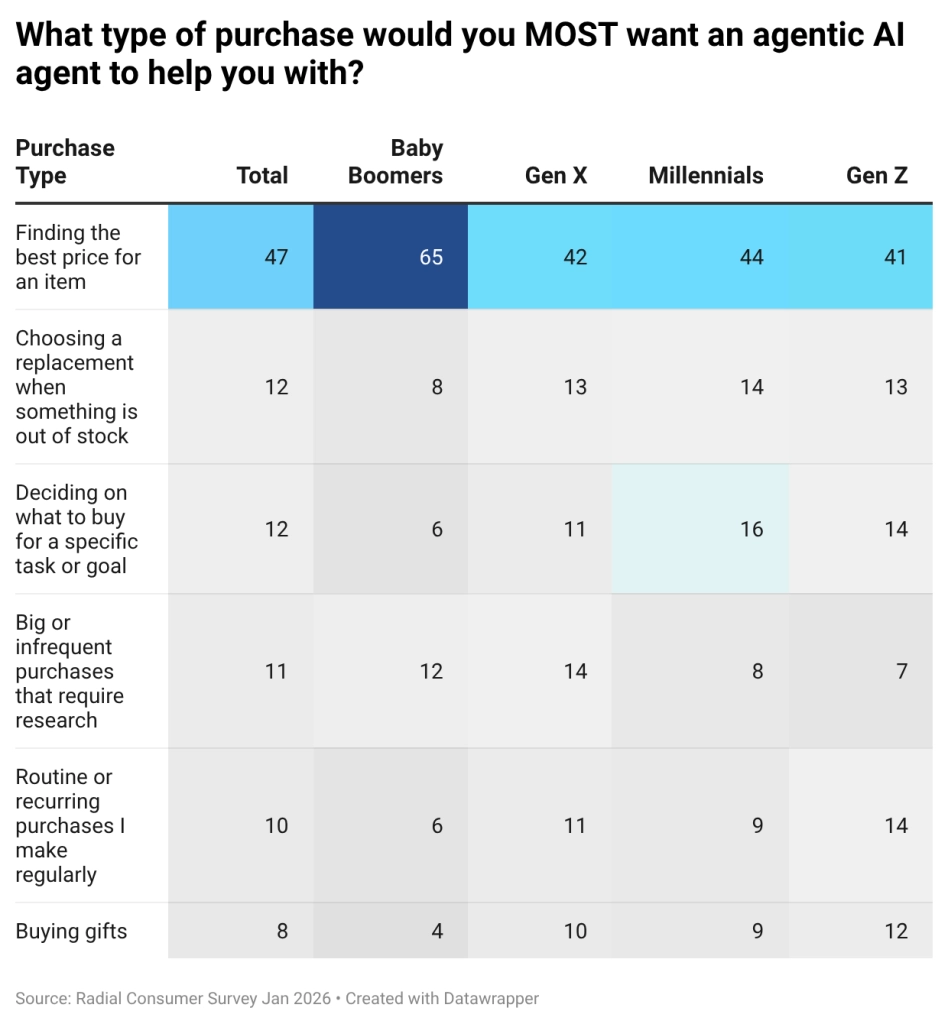
Per Radial’s recent research into AI adoption, consumers currently start shopping with traditional channels. Only 5% of shoppers start their search with AI tools. Many begin shopping on search engines (e.g., Google) and marketplaces (e.g., Amazon) where AI tools are embedded, however. When they do interact with AI, consumers are most interested in agentic commerce when they are certain that they can get maximum value or discover interesting deals. Shoppers want AI to help them find the best prices for a purchase (47%). This far outpaced other use cases like deep personalization or transaction management.
Leading brands can plan for future innovations while focusing on what shoppers really want today: AI-sourced deals designed to maximize value and simplify shopping journeys.
Leverage AI to Direct Traffic to Your Products
Current AI products are useful for directing traffic to retail sites, and customers may overcome their anxieties for the utility of quickly accessing and purchasing what they’re looking for. As long as retailers structure their sites and product information so that AI models can effectively parse and generate accurate results, this could be an early use case for agentic commerce for many brands. Simple, positive shopping experiences can reward customers while building the bridge toward more complex agentic commerce.
Target the Demographics Most Open to AI Today and Establish Trust Early
Brands can also drive the early adoption of agentic commerce by targeting the demographics most interested in AI today. Per Radial’s research, 53% of Millennials and 50% of Gen Z shoppers are somewhat-to-very likely to purchase a brand recommended by AI. But these younger shoppers are only interested in AI tools if they create trustworthy experiences. Brands may not get a second chance at creating the right agentic experience, with Gen Z shoppers in particular growing more anxious and angry with the use and misuse of AI more generally.
Establish Secure, Controlled AI Experiences
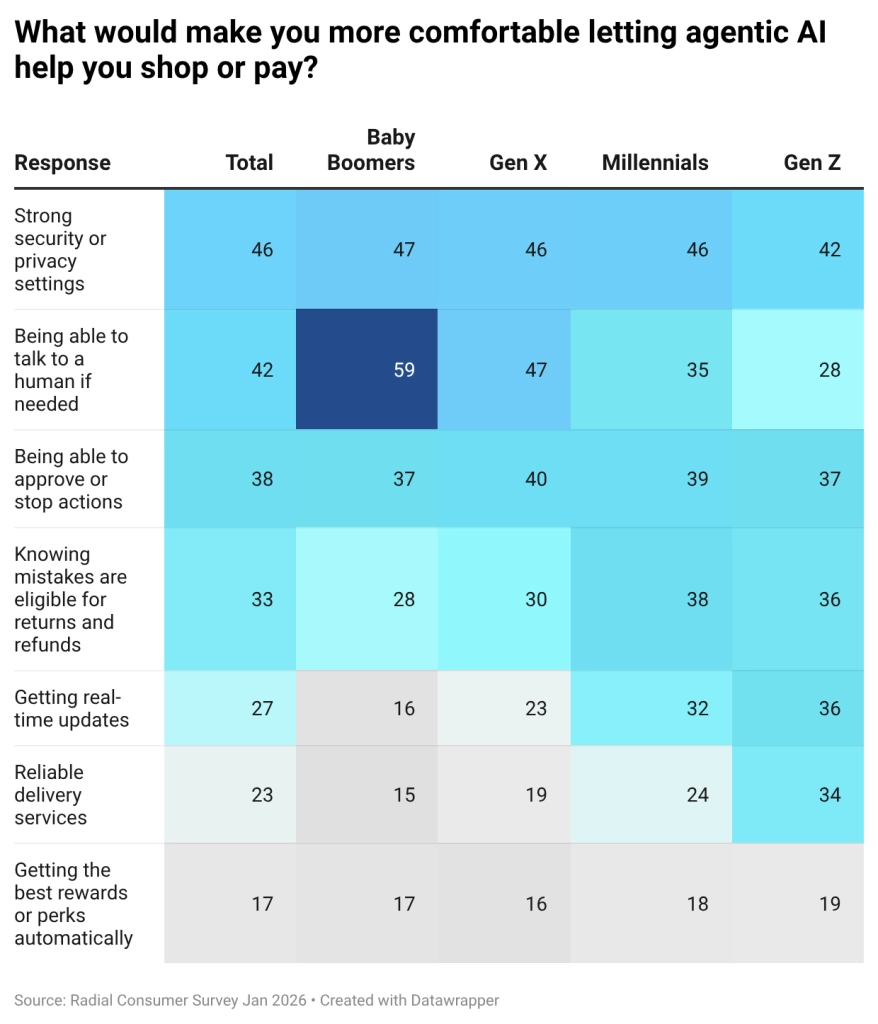
Trust is transactional, and it’s built over time. While a person may trust a retailer, their store, and their human staff, they may not yet be comfortable trusting an abstract AI agent. Today, even when offered time or cost-savings, 34% of consumers would allow an AI to only take approved actions, while 23% want it to make suggestions only. Over one-fifth of shoppers don’t want an AI agent to act on their behalf at all.
This is a serious hurdle for brands seeking to optimize their buyer journeys and retail operations via AI tools.
Ultimately, retailers can only drive the long-term adoption of agentic commerce by their loyal customers when they create secure shopping experiences that meet their shoppers’ needs. Building trust will help shoppers embrace more complex use cases beyond boosting site traffic or discovering new deals. That means retailers must start with security in mind to create transparency and accountability around their use of AI tools.
As brands build trust over time, they can develop, test, and implement new AI use cases. For example, consumers are relatively disinterested in letting AI help make buying decisions today, but they may become interested as they gain trust in both the brand and its AI tools over time.
Expand Post-Purchase AI Optimizations
While shoppers may hesitate to use AI tools as part of the purchase process, they are generally open to AI support after they make a purchase. Thirty-six percent of consumers are cautiously interested in AI assistants working directly with stores or delivery systems to order, track, or fix issues. Fifty-three percent of consumers are open to using AI for monitored delivery and problem-solving.
Brands can take multiple paths to AI optimization, focusing on carefully designed customer-facing agentic experiences while more rapidly implementing agentic tools operationally to streamline the post-purchase fulfillment, distribution, and delivery processes.
Create Seamless Experiences from Click to Delivery
No matter how retailers choose to implement AI, they must anchor on providing seamless, high-quality experiences for their customers. That requires leveraging AI strategically, focusing on secure designed experiences that shoppers will embrace. In parallel, it can also mean developing operational improvements with new tools and technologies. That often means working with the right technology and logistics partners to create great shopping journeys from storefront to order delivery. The right partners can accelerate agentic commerce for modern brands while securing long-term customer loyalty via great, trustworthy experiences.
For example, flexible, technology-driven logistics partners can ensure inventory availability, product delivery, and streamlined returns—all while providing the necessary structured data to AI integrations. Quality data, combined with deep operational expertise, allows agents to converse across protocols and make decisions on behalf of their customers.
Ultimately, brands cannot create great agentic commerce alone. The right combination of AI-driven technologies, people, processes, and partners will pave the way to long-term customer satisfaction and establish leading retailers at the forefront of the agentic commerce paradigm shift.
About the author

Discover Radial’s latest research on consumer adoption of agentic commerce.
