
The New Guide to Returns in 2026
Returns are a part of life, and shoppers make a lot of them. Discover the complete guide to returns in 2026.
Returns are a part of life, and shoppers make a lot of them—especially with online orders. eCommerce return volumes are three times higher than physical retail returns. And returns create a persistent challenge for eCommerce brands. Customers have high expectations for returns, but ultimately retailers have to navigate the operational and financial burdens of managing them. In 2026, that means retailers must optimize returns processing to mitigate returns challenges and maximize the value of returned inventory. All while creating the kind of experience that rewards and retains loyal, long-term customers. That’s not even factoring in the massive influx of returns generated by the peak holiday shopping season, which exacerbates returns challenges at the beginning of the new year and amplifies the importance of great customer experiences.
Radial and Two Boxes understand the unique challenges returns processing creates for retailers, and we have the data-backed perspective they need to optimize returns throughout the year. We created this guide to showcase our data-driven insights into the key retailer and consumer returns trends that will shape commerce in 2026 and beyond.
To dig deeper into the key trends surrounding retail returns and the reverse supply chain, Radial and Two Boxes launched a multi-industry retailer survey and a US consumer survey. We discovered key insights into both the challenges and opportunities retailers have within their returns processes, as well as how consumers experience making returns.
What do Shoppers Expect for Returns?
Our data revealed a key trend–one many retailers know well. Consumers do not like making returns. For nearly half of consumers, the most frustrating element of returns is the fact that they must return a product at all. That makes sense: It’s disappointing when a product doesn’t meet expectations, and that frustration can build with the additional steps required to make a return.
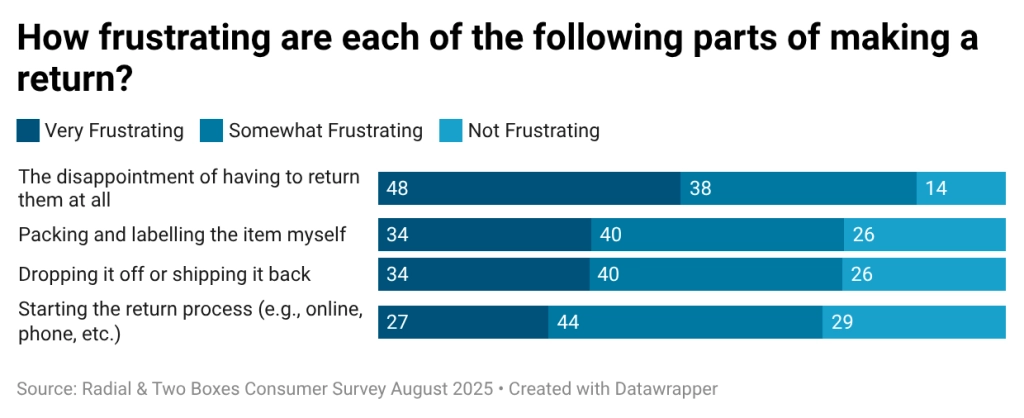
Returns can be so frustrating that up to 71% of shoppers will simply keep products they don’t want, and won’t be purchasing again, rather than deal with returns processes. This creates an uphill battle for retailers, who already bear the burden and costs of the return itself. They face lower customer satisfaction and still need to balance internal policy and process changes to accelerate product disposition and minimize costs with customer satisfaction.
Consumers Consider Tradeoffs Over Refunds
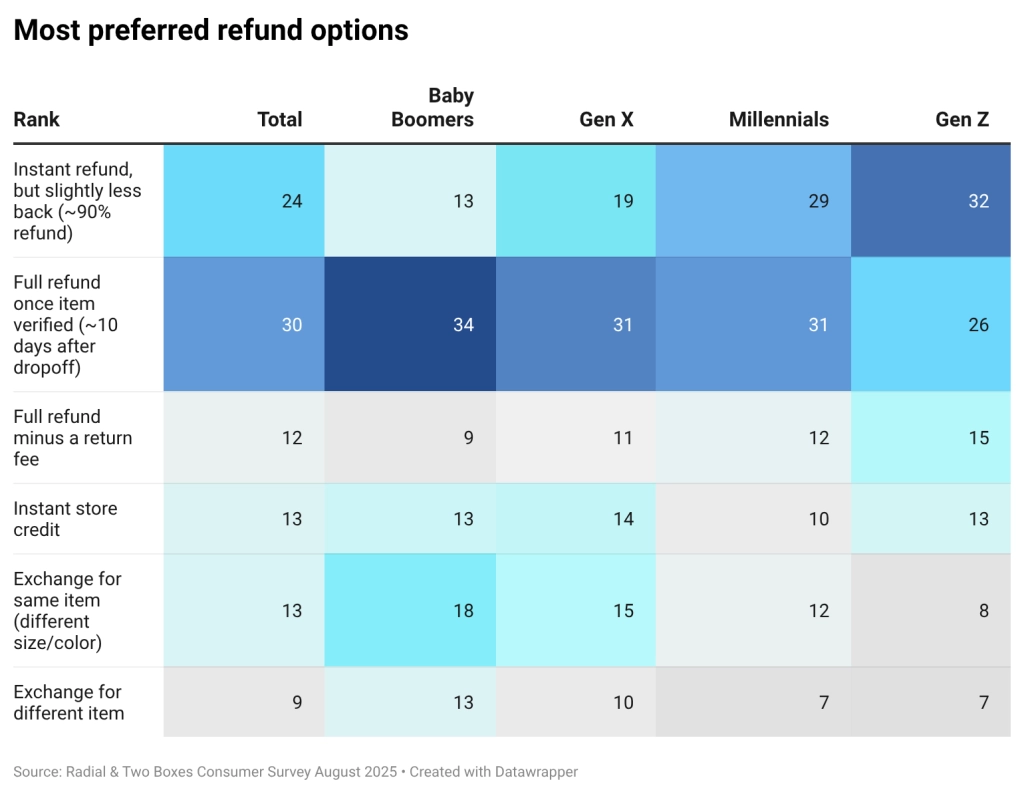
Consumers also create a challenge for retailers when it comes to return refunds. Brands have a tricky balance to achieve when it comes to preferred refund options. Consumers expect the ideal return experience by default, but as retailers look to design a great customer experience while protecting their bottom line, it’s important to understand the friction consumers are willing to take on in the returns process. For example, 30% of consumers are willing to wait a little longer for a full refund, while 23% accept an instant refund with slightly less money back. Interestingly, this trend shifts by generation. Baby Boomers are most likely to wait for a full refund and are the least likely to seek an instant refund with slightly less money back. Younger shoppers, especially Gen Z, are more open to instant refunds. Additionally, Gen Z is the most likely to accept a full refund minus a return fee, albeit at only 15%.
Consumers are not particularly interested in exchanges. Only 13% of shoppers are open to an exchange for the same item and only 9% are open to a different item exchange as a top option. This indicates that the majority of returns are not due to a sizing, fit, or usage issue, in which case shoppers like a product but need a better “fit”. There could be a variety of factors for exchange frustration, including frustrations with quality, blind buying boredom, or selecting a better fitting alternative from another brand. Either way, shoppers don’t want to make a brand-specific exchange when other options are available.
Shoppers do not Want to Pay Return Fees
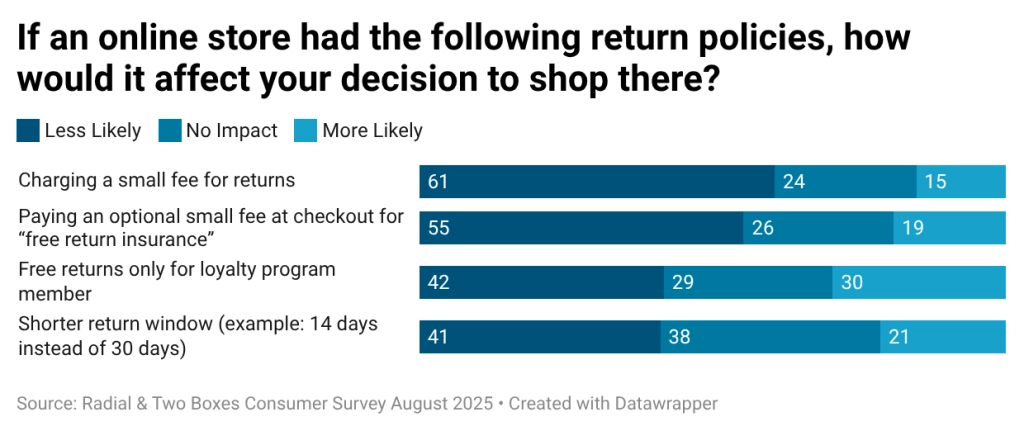
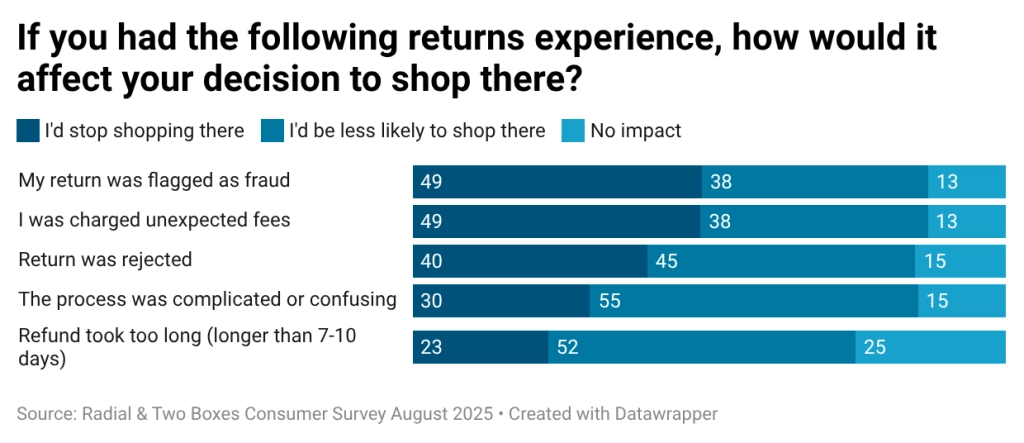
Shoppers want refunds, but they don’t want to pay for returns. In fact, 61% of consumers say paying return fees will make them less interested in shopping with brands again. While they are open to other return policies, like shorter return windows or even free returns for loyalty members only, they are not interested in paying anything additional for a return. Any kind of fee associated with a return seems to indicate a negative perception from consumers. Consumers also respond negatively to false fraud allegations. 49% of shoppers will stop shopping with a retailer that flagged a legitimate return as fraudulent. An equal amount will stop shopping if they are charged with surprise fees. With this in mind, brands should be careful how stringent their predictive fraud detection and prevention becomes.
Shoppers Create a Returns Fraud Problem for Retailers
As we will discuss in further detail later, retailers face significant challenges with returns fraud and abuse. Importantly, Radial and Two Boxes’ research indicates a disconnect between how retailers and consumers view returns fraud and abuse. Shoppers find certain types of fraud acceptable, even normal, while retailers feel the pain of fraudulent returns.
Consumers View Fraud and Abuse Differently than Retailers
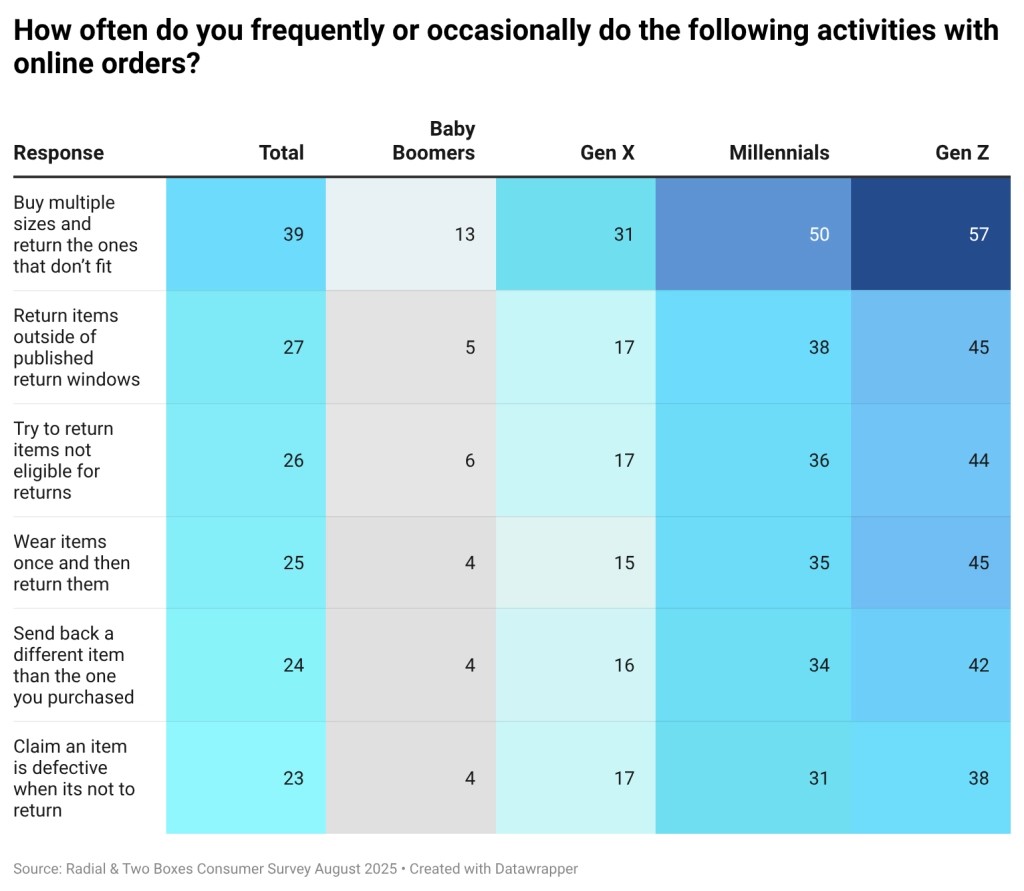
There are fundamental differences in how consumers define returns fraud and abuse. One big example: Consumers are generally more open to “friendly fraud”, like bracketing (purchasing multiple items in different styles and colors with the intent to return them) and returning items outside retailers’ published return windows. This is particularly true for younger shoppers, where for instance, 57% of Gen Z and 50% of Millennials frequently or occasionally bracket.
Importantly, when we look at the demographic data, younger shoppers tend to expand their focus beyond “friendly fraud” and into other categories of more malicious fraud. Millennials and Gen Z are more likely to return items that are not eligible for returns. And while the rates are lower compared to friendly fraud like bracketing, younger generations are more likely than older shoppers to send back different items than the ones they purchased and to claim items are defective. Forty-two percent of Gen Z shoppers at least occasionally switch items, compared to only 4% of Baby Boomers. To navigate the growing population of younger shoppers open to at least some types of returns fraud, retailers will need to carefully examine and improve their fraud detection processes.
Retailers Must Understand Consumers to Truly Optimize Returns
Retailers can optimize their overarching returns management by first understanding how and why consumers make returns. Additionally, they must consider how shoppers view returns fraud behavior–and how younger shoppers are evolving their fraud activities. With data in hand, retailers can then reassess the elements that make their customers’ return experiences great: from returns options, timelines, fee requirements, and fraud automation. The bottom line: They must reward great customers via a streamlined returns process while weeding out bad actors.
Retailer Perspectives on Returns in 2026
With key consumer trends in our back pockets, it’s time to dive into retailers’ perspectives. Our analysis uncovered overarching insights and trends across industries, including the state of return rates, key returns challenges for retailers, returns fraud issues and how retailers work with 3PLs to help manage returns.
Returns Normalize at High Rates
eCommerce returns are stabilizing at high rates after spiking amid the COVID-19 pandemic. Consumers are comfortable with making eCommerce returns and even embrace return policies as a way to try out multiple sizes or versions of merchandise. While consumers have high expectations for returns, it’s retailers that must juggle costs, complexities, and returns challenges–all while creating a great customer experience. This is especially challenging during and after the hectic holiday season.
While nearly one-third of retailers see returns increasing, 71% perceive them as staying about the same or decreasing. This indicates that return rates are stabilizing after a hectic period starting in 2020.
Retailers Consider Fraud and Abuse the Top Returns Pain Point
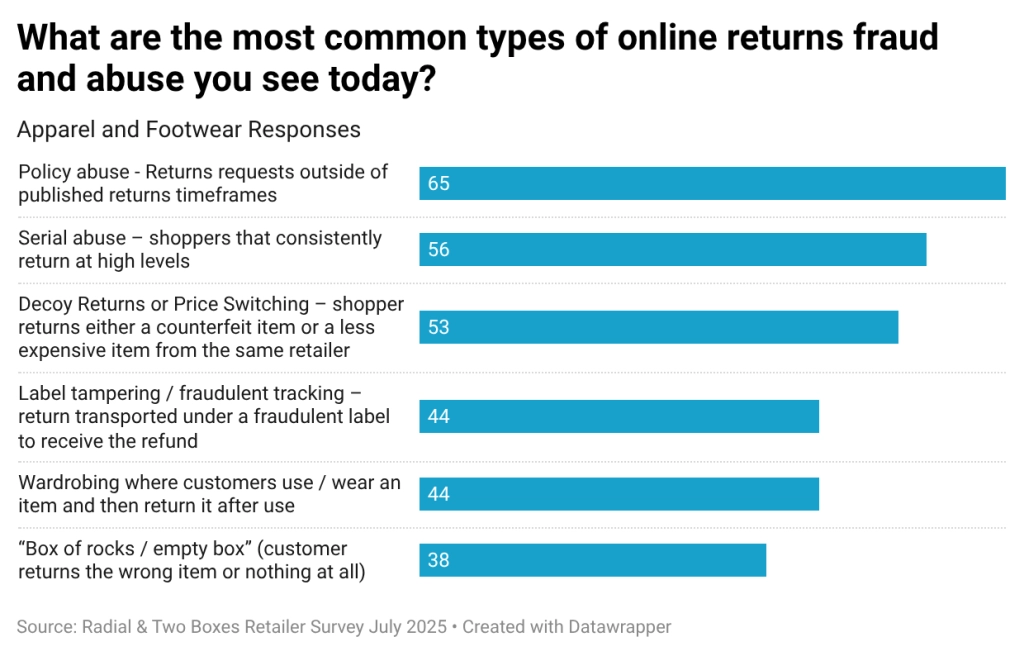
44% of brands describe managing returns fraud and abuse as the biggest pain point in their current returns process. As consumers blur lines with “friendly fraud”, and bad actors grow bolder, fraud methods are growing more complex. For example, retailers list label tampering and fraudulent tracking as the top issue, followed by serial abuse and policy abuse. This may indicate that fraudsters are growing more sophisticated as simpler decoy and empty box returns fall further down the list.
Retailers Focus on Reducing Potential Return Losses
When it comes to returns processing and dispositioning, brands focus on maximizing value and reducing potential losses whenever possible:
- The majority of brands (59%) resell between 11% and 50% of their returns through existing channels to maximize their return-to-stock opportunities.
- Some retailers turn to third-party resellers, with over a third liquidating 11-25% of their returns and 15% liquidating up to 50%.
- Retailers also seek to drive returns value through manufacturer credits, as well as outlet and clearance options.
Ultimately, retailers seek disposition options that reduce the need to destroy, donate, or recycle products. But many retailers may still need to improve grading, restocking, and future commerce options to maximize the value of returned inventory long-term.
Nearly Half of Retailers Manage Returns In-House
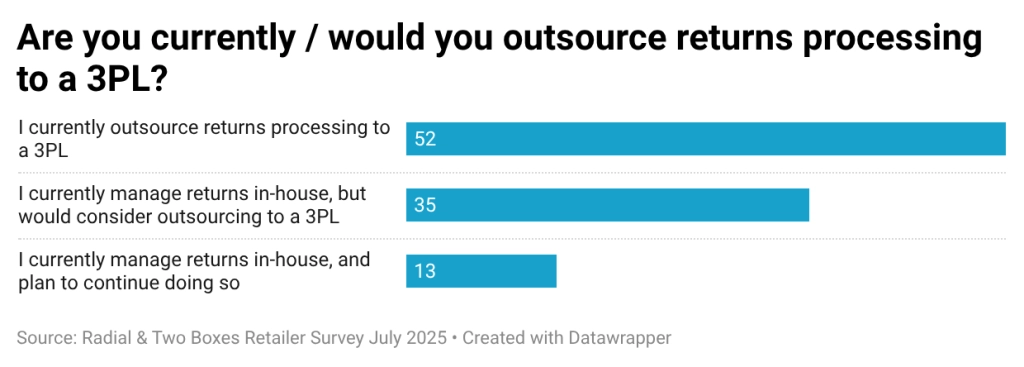
Nearly half (48%) of surveyed retailers currently manage returns in-house. While brands work with external partners as they grow, some brands opt to manage returns in-house, even at scale. Over one-third of brands managing returns internally would consider outsourcing to a third-party logistics (3PL) partner, however. In-house returns management can create significant operational headaches as brands grow and scale. It requires dedicated labor, processes, and technology considerations to manage efficiently and effectively—all while mitigating potential fraud and navigating customer service requirements.
Retailers Engage with Logistics Partners to Reduce Returns Cost
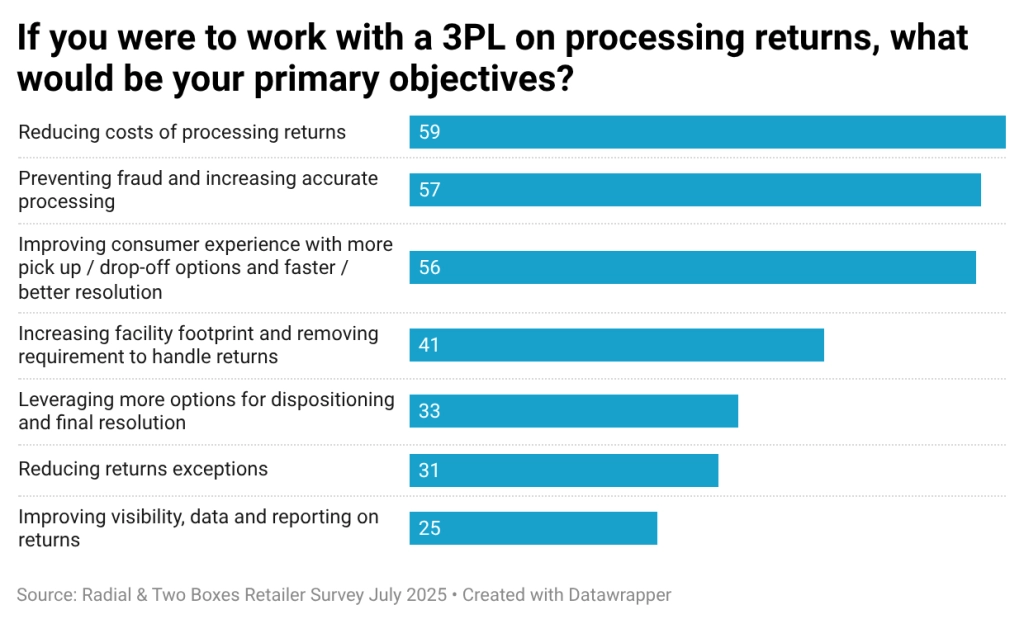
As previously noted, retailers consistently seek to reduce costs and drive value from their returns processes. For those that choose to work with 3PLs, 59% do so to reduce returns costs. Over 56% of retailers seek partners to support fraud prevention, improve returns accuracy, and improve the consumer return experience with more pick-up and drop-off options.
Retailers turn to logistics experts to support operations in order to drive revenue and customer retention. Selecting the right partner is critical. In fact, 28% of brands will likely stop working with a 3PL over poor returns operations. This signals the need for 3PLs to ensure returns processing capabilities are optimized.
Modern Brands Expect Great Returns Management From Their 3PLs
While many modern retailers manage returns in-house, they are increasingly seeking to outsource the process to third-party logistics providers (3PLs). When they do decide to outsource, brands have high expectations.
- 3PL partners must be returns experts, not just fulfillment pros: 66% of retailers believe that it is important or very important that their order fulfillment partners can process returns effectively. And 57% are most likely or likely to end a relationship with a 3PL over poor returns capabilities.
- Retailers primarily seek to reduce returns costs and outsource operations: 59% of retailers consider reducing costs and outsourcing returns processes as their primary objectives when working with a 3PL to process returns. A further 57% seek to prevent fraud and increase processing accuracy.
- Returns payment services, processing services, and transportation top the list of desired 3PL capabilities: Retailers are most likely to work with 3PLs when they offer payment services (64%), optimal returns processing (52%), and returns transportation solutions to balance speed and cost (46%). And they have high expectations for data-driven reporting to ensure reliable, cost-effective returns processing occurs day-after-day.
Fulfillment Partners are Positioned to Optimize Returns for Modern Retailers
Retailers will always need to manage returns, but they don’t have to be painful. 3PL partners are uniquely positioned to help brands across industries solve the biggest returns pain points. Retailers benefit from the combination of highly experienced operators working with leading technologies to reduce costs and tailor return policies to benefit loyal customers while disincentivizing fraudulent bad actors.
- Leverage proven processes and technology enhancements to accurately detect and mitigate returns fraud, all while creating one-to-one policies designed to reward your most loyal customers.
- Improve returns processing time and return-to-stock rates to improve inventory health.
- Provide the visibility to track and report what matters to brands.
- Implement customer-focused solutions developed through deep cross-industry experience and by obsessively tracking consumer expectations.
About the author

Learn more about scalable, reliable returns management.
