
The Complete Guide to Top Retail and Consumer Trends
Dive into Radial’s complete guide to key retail and consumer trends.
Change defined 2025. And that uncertainty led to anxiety across both business leaders and consumers. They faced tariff questions and economic uncertainty, as well as shifts in consumer expectations across demographics. Modern brands need to quickly assess and navigate these changes to meet customers’ needs and beat the competition.
With that in mind, Radial launched a series of surveys to better understand the key retail and consumer trends—and how it will affect both brands and consumers moving forward.
Retailers Face Fulfillment Challenges
When Radial launched a retailer survey in March 2025, we discovered one overarching theme: growing and scaling is hard to do.
- 47% of all respondents cited the ability to manage growth and scale with their existing fulfillment strategy as a significant challenge. And 54% of small businesses (where revenue equals $35M to $50M) cite this as their primary challenge.
- 44% noted their limited ability to add new channels and capabilities as a primary challenge.
- 40% face technology issues, where a lackluster fulfillment tech stack stymies them from executing their growth strategy.
- 51% of respondents note that chargeback fraud is their biggest fraud related challenge, while 43% struggle with returns policy abuse.
But modern brands can’t let these challenges stop them. And the first step may be to reassess how they are managing their fulfillment today.
The Limits of In-House Fulfillment
At a certain point in their growth journey, modern brands must reassess their fulfillment strategies to grow and scale effectively. But many still struggle to manage fulfillment in-house, despite operational challenges. In fact, the majority of modern brands rely on in-house fulfillment solutions with either multiple (70%) or single (59%) facilities for at least some of their fulfillment needs. Only about 40% or less rely on outsourcing to manage some or all of their fulfillment needs.
In-house fulfillment can work for emerging brands but creates challenges as these brands grow and operations become more complex.
The Drawbacks of In-House Fulfillment
- Highly resource intensive
- Requires capital to scale effectively
- Distracts brands from focusing on core competencies like operational strategy and product development.
- Creates fulfillment challenges as brands evolve to meet customers’ high expectations.
The Trend Toward Outsourced Fulfillment
As brands grow, rising operational complexity means they often seek a third-party logistics (3PL) partner. Though it varies somewhat by revenue size, more than half of all surveyed brands commonly outsource fulfillment once they grow to $50M+ in revenue.
- 57% of organizations with $50-$100M in revenues outsource some or all of their fulfillment.
- 72% of organizations with $100-$150M in revenues outsource some or all of their fulfillment.
- 76% of organizations with $150M-$200M in revenues outsource some or all of their fulfillment.
But this comes with challenges.
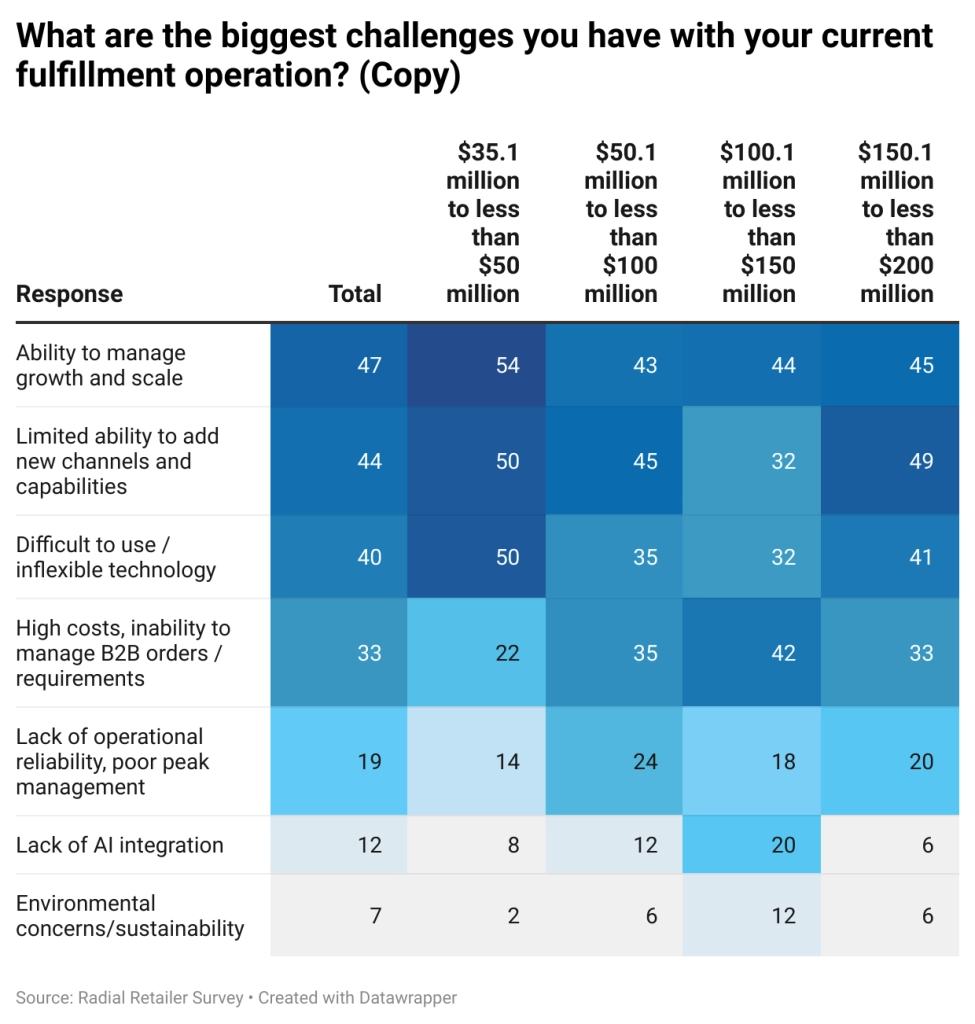
Small brands tend to have more issues with growing pains, like managing growth and scale combined with their own tech stack limitations. But as brands grow, challenges shift. Larger brands still deal with growth challenges, channel limitations, and inflexible technology, but they also begin to face higher costs and complexity for B2B orders, as well as dealing with more issues during peak.
To grow and scale effectively, modern brands can develop a partnership ecosystem designed to support their entire supply chain and industry-specific needs. They also need to assess partners for the right balance of technology, scalability, and operational expertise necessary to solve their specific fulfillment challenges.
Transportation Challenges Evolve as Brands Grow
Brands of all sizes face transportation challenges—but our research shows they face them in distinct ways.
Smaller Brands Struggle with Transportation Fundamentals
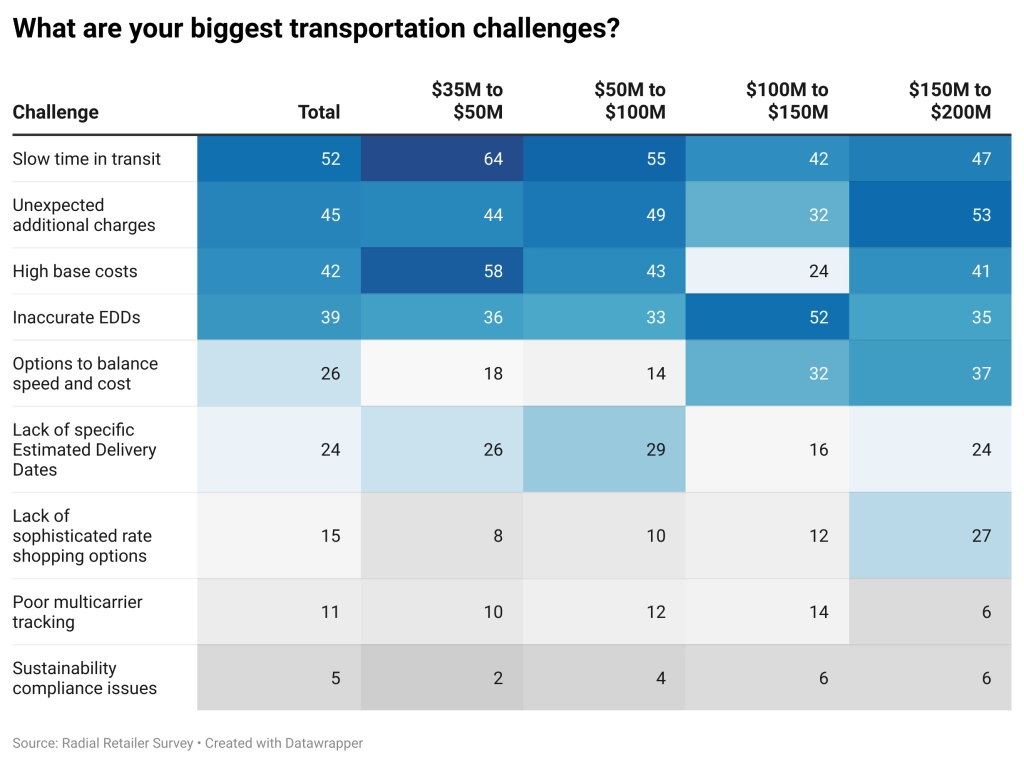
Smaller brands face fundamental transportation challenges. And they are challenge that could cost them customers. The first challenge: slow time in transit. Shoppers expect fast shipping. Per Radial research, 29% of shoppers expect 2–3-day shipping, and 45% expect 3–5-day shipping. But 64% of brands with revenues between $35M-$50M struggle with slow transit times. Over half of brands between $50M-$100M also see slow transit times as the number one transportation issue. Slow transit times means that these brands are forced to either offer slower delivery options or run the risk of missing their delivery promises. They can’t meet customers’ delivery expectations. The result: abandoned carts, lack of repeat purchases, and unhappy customers.
Smaller brands face another challenge: high base transportation costs. Fifty-eight percent of smaller brands face higher base costs. They may incur them because smaller brands can’t achieve the carrier discounts larger brands receive. They simply lack the volume necessary to reach higher level carrier discount tiers.
Larger Brands Face Transportation Optimization Challenges
While unexpected additional charges affected 45% of all respondents, it is felt acutely by larger brands at 53%. Larger retailers also struggle to balance speed and cost (37%), and they often miss sophisticated rate shopping options (27%). These challenges may occur in part because these larger brands work with multiple carriers—something that is both resource intensive and complex. There are often paths forward to optimize transportation costs through industry partners known for their transportation solutions.
Retailer Platform and Channel Trends
As modern brands grow, they often seek new platforms and channels in which to connect with customers and make sales. Radial focused on key trends surrounding platform and channel expansion in 2025. We noted that 44% of modern brands report their limited ability to add new channels and capabilities as a primary channel, but many continue to optimize their platform and channel mix to drive scalable long-term growth.
The Top eCommerce Platforms, and Why They Matter
As brands grow, they seek eCommerce platforms to optimize operations, connect them with relevant channels, and improve their customers’ experiences. Per Radial’s retailer survey, there are clear front runners:
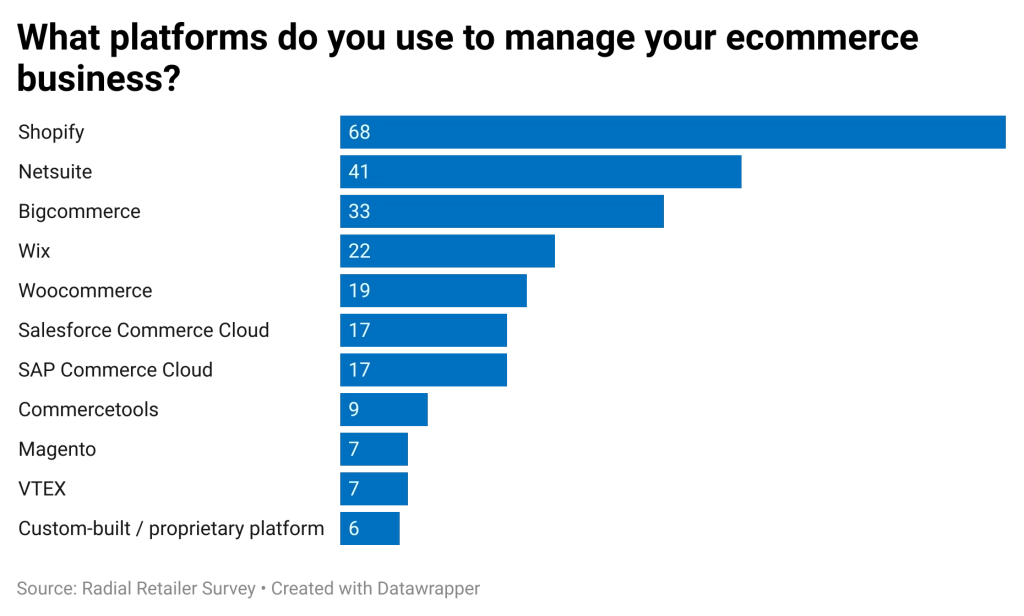
- 68% of surveyed brands choose Shopify to manage their eCommerce business. While Shopify is the clear front-runner across brands of all sizes, it is selected by 74% of small brands ($35M-$50M).
- Brands also choose NetSuite (41%) which includes both an ERP and CRM, and 51% of large brands ($150M-$200M) prefer it.
- One third of brands work with Bigcommerce’s platform, which is less app dependent.
Larger brands choose NetSuite and Bigcommerce because their needs change as they scale. As another example, while Salesforce Commerce Cloud or SAP Commerce Cloud are not in the top five platforms among surveyed retailers, they are more often selected by large businesses requiring different functionality from their eCommerce platforms.
Brands Expand Retail Channels into DTC and Marketplaces
Brands start by selling through their own websites, with 72% of respondents indicating their website serves as their primary channel. This breaks down interestingly by industry:
- 89% of home furnishing brands sell primarily via their own websites.
- 81% of apparel companies sell primarily via their own websites.
- 69% of sporting goods brands sell primarily via their own websites. The difference between it and home furnishing and apparel may be linked to consumers’ desire to shop in stores.
These category retailers establish their brand identity and promise via an owned customer experience before venturing on to new channels and selling models. Brands do seek to add new channels to expand customer bases, improve cost savings, and expand fulfillment capacity, however. This most often means working with online big box retailers or marketplaces first.
Walmart and Amazon Marketplaces Tie for Brands, but There’s a Catch
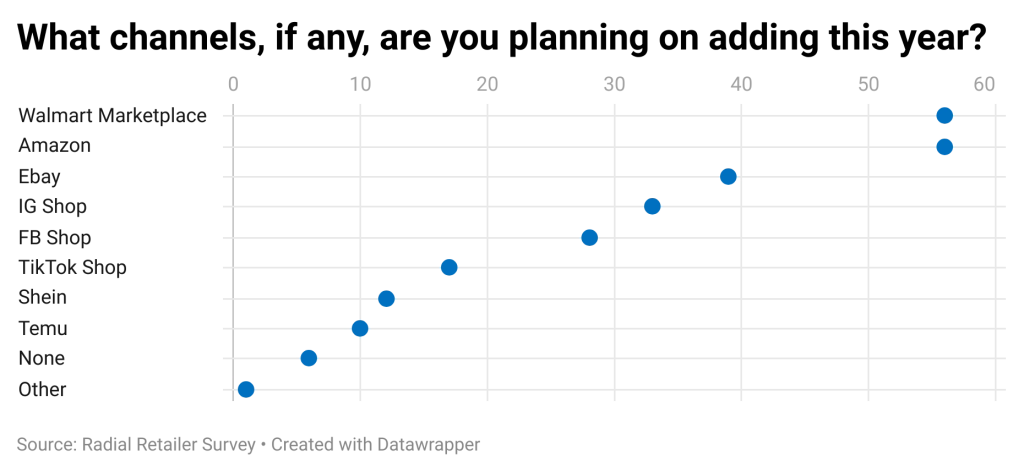
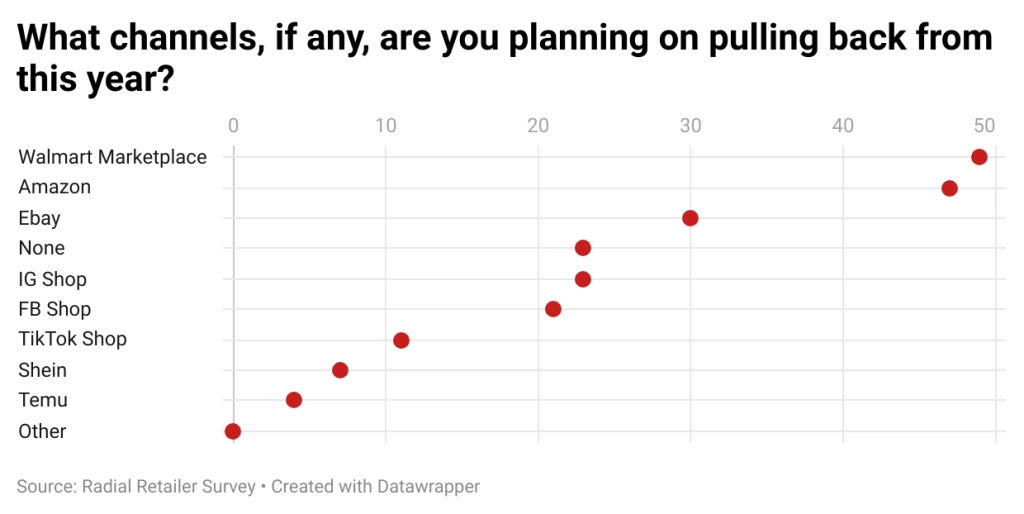
Retailers are clear when it comes to which marketplaces they plan to add. Walmart and Amazon tied at 56%. This makes sense: Large online marketplaces provide opportunities for modern brands to reach large audiences, and there is a trend of brands moving toward marketplaces as they grow in revenue size.
But there’s a catch: Walmart and Amazon are also marketplaces brands considered shifting away from—at 49% and 47% respectively. While brands can grow by moving to where customers shop, many retailers are managing a balancing act. They discover new customers in large, well-established marketplaces, but they simultaneously deal with the stringent requirements and high fees often associated with these marketplaces.
We noted that smaller brands are beginning to consider Walmart’s marketplace. Walmart leverages a rigorous onboarding process, but there is currently less competition in the marketplace than Amazon driving up visibility with customers.
Where Emerging Channels Fit in 2025
Brands are interested in newer, emerging channels—like TikTok Shop, Temu, and Shein. But in 2025, they are not prioritizing them as highly versus more established channels. Small brands (with revenues between $35M-$50M) are specifically deprioritizing emerging channels, with just 14% selling on TikTok and 4% selling on Shein and Temu. They show similar levels of interest in adding these channels in the future. These brands instead focus on large channels like Amazon and Walmart, where they have access to more customers.
Larger brands (with revenues between $100M-$200M) take more interest in emerging channels. More than 20% show interest in TikTok and 14% in Temu. Many of these larger brands already have a presence in more established marketplaces, and they are likely looking for new ways to grow.
What Returns Management Looks Like for Modern Brands
According to an August 2024 Radial research study, 61% percent of consumers returned at least one online order in the last year. Forty-three percent returned up to 5 orders.2 Of those, apparel, shoes, and accessories are returned more often than any other products, with 64% of consumers making returns in at least one of those categories.
In some categories, shoppers buy already planning to make returns. Retail Dive found that 87% of consumers purposefully order extra apparel items to try on at home. They then return what they do not want. Retailers call this trend “bracketing.”
Bracketing is when a shopper buys multiple sizes, colors, or styles of a product with the intent to return most of the purchased items. For retailers, this means that margin calculations, inventory management, and operations workflows become more unpredictable.
Shoppers Expect Great Returns from Modern Brands
Shoppers expect a seamless returns process—from refund through to returns drop-off or shipping. If the returns process creates friction for customers, they will notice and respond. Per Radial’s research, refund processing was the top consumer complaint. Packing items for return shipping was also a common issue, particularly for online apparel orders. Eighteen percent of consumers experienced issues with return packaging or labels and 16% struggled to find return instructions.
Modern Brands Primarily Work with Happy Returns
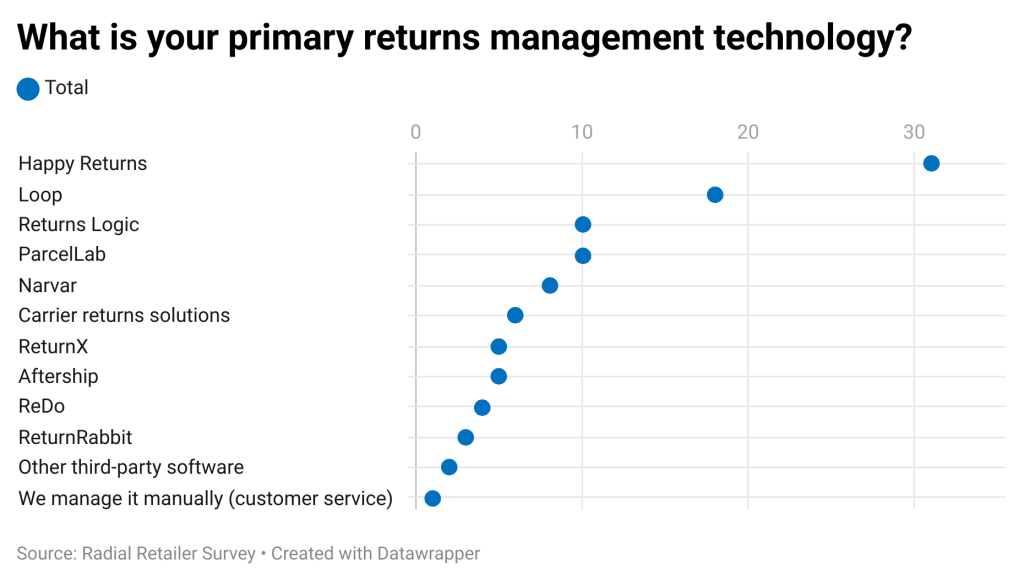
Modern brands seek to optimize the returns management process and meet customer expectations by working with a third-party partner. In fact, nearly one third of brands use Happy Returns to support their returns management processes. A further 18% work with Loop, with 26% of small brands ($35M-$50M) choosing it. Only 1% of surveyed brands manage their returns manually.
Consumers Have High Expectations for Modern Brands
To win customers amid uncertainty, modern brands must first ask: What do consumers really want? Per Radial’s research, the answer centers on quality. But this quality has two elements—and modern brands need to achieve both to win long-term loyalty.
Quality Products Win Customers
Per Radial’s March 2025 consumer survey, 32% of consumers say product quality is the top reason they choose to buy from a DTC brand, and 29% are motivated by access to unique products they can’t find anywhere else. Sixty-two percent of consumers say that declining product quality will cause them to lose trust in a brand. This mirrors similar trends Radial uncovered in the home furnishings and sporting goods industries.
Quality provides the initial reason consumers buy from a brand. But today, that’s no longer enough to earn customers’ loyalty. They want more.
Quality Fulfillment Keeps Customers
Products aren’t what keep customers—it’s operational performance. According to Radial’s survey, 72% of consumers say shipping speed and reliability are the most important factors in deciding whether to buy from a DTC brand. Product availability (66%) and easy/free returns (63%) rank even higher than values like brand identity or personalization. While brand values resonate with 38% of shoppers, and personalized recommendations with 25%, the data shows that it’s the full order experience—from shopping cart to delivery—that drives conversions and long-term loyalty. For modern retailers, branding drives interest, but great fulfillment builds trust.
Quality Fulfillment Is a Competitive Advantage
At a certain point in their growth journey, modern brands must reassess their fulfillment strategies to determine how best to scale. We already unpacked retailers’ challenges when it comes to growing and scaling. And 70% of brands still rely on in-house fulfillment. In-house fulfillment often works for emerging brands but creates challenges as these brands grow and operations become more complex. Worse, it also causes modern brands to lose customers.
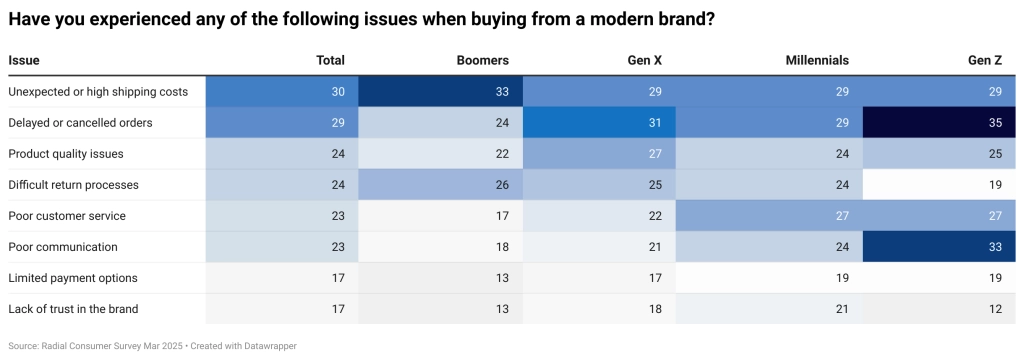
Nearly 40% of consumers stopped buying from a brand they liked because the brand couldn’t keep up with demand. Delayed or canceled orders (29%), unexpected shipping costs (30%), and difficult returns (24%) create a customer experience that contradicts the polished image many of these brands present. It breaks the fulfillment promise shoppers expect when they order.
Younger shoppers are particularly unforgiving. Gen Z (35%) and Millennials (33%) report the highest frustration with delays and lack of communication, reflecting expectations shaped by Amazon-era convenience. Baby Boomers, on the other hand, are more sensitive to price-related friction, with 33% abandoning carts due to high shipping costs.
The next chapter for brands isn’t about reinvention—it’s about reinforcement. As brands mature, they need logistics infrastructure that matches the pace of their growth.
Radial’s survey data illuminates the challenges and opportunities ahead for modern brands. Change presents challenges, but brands can maximize their success with the right strategies. They can develop strategies focused on positioning products in the right channels, with seamless fulfillment and distribution. And they can ask key questions about which 3PL partners help them grow and scale quickly. The result: Brands can meet their customers’ expectations, create long-term trust, and elevate their products in highly competitive markets.
The Radial Difference: Drive Quality Fulfillment with Radial Fast Track
The evolution of retail requires a new kind of infrastructure—one that matches the changing needs of the brand while providing the reliability of enterprise-grade operations.
Radial has the solution: Radial Fast Track. Radial Fast Track provides scalable, cost-effective fulfillment for modern brands, without upfront costs or long-term contracts.
Radial Fast Track can help brands solve fulfillment bottlenecks and provide fast, reliable, and cost-effective fulfillment to customers:
- Transition from in-house fulfillment to outsourced fulfillment: Onboard easily, with the ability to integrate in as little as a week—minimal resources required. We streamline fulfillment so that brands can focus on what they do best, knowing their customers get the experience they deserve.
- Faster, cost-effective shipping: Simplify delivery with Radial’s last mile solutions. We work with carriers to find the best balance of speed and cost.
- Expand your brand, grow, and scale: Connect with hundreds of DTC and B2B channel partners quickly and distribute seamlessly.
- Ditch returns headaches: Leverage streamlined technology and processes. Make returns easy.
About the author

Learn more about fast, scalable fulfillment.
