
Designed Agentic Experiences: What Today’s Shoppers Expect
Radial’s recent research into AI adoption and agentic commerce demonstrated that shoppers may not be prepared to adopt AI in their daily shopping journeys yet. Retailers can win and keep customers by integrating AI into their commerce experiences—but they will need to design these experiences carefully.
Radial’s recent research into AI adoption and agentic commerce demonstrated that shoppers may not be prepared to adopt AI in their daily shopping journeys yet. They may hesitate to use new AI functionality unless the experience is secure, trustworthy, and provides quality results. But brands can still achieve results with the right use cases. Retailers can win and keep customers by integrating AI into their commerce experiences—but they will need to design these experiences carefully.
Consumers Cautious About Agentic Commerce
Brands may be on the threshold of rapid AI advances, but their customers may not yet be ready to take the plunge into agentic commerce. Recent polls show that American consumers are highly apprehensive about the impact of AI on society overall. And when it comes to agentic commerce, Radial’s research demonstrates that shoppers are unwilling to fully engage with agentic AI unless they feel secure and in control. Even when offered time or cost-savings, 34% of consumers would allow an AI to only take approved actions, while 23% want it to make suggestions only. Over one-fifth of shoppers don’t want an AI agent to act on their behalf at all.
Shoppers are particularly disinterested in AI agents making purchases on their behalf. EMARKETER indicates that 44% of consumers don’t trust AI at checkout—or at the very least need to check results. Per Radial’s research, if they do choose to leverage AI while shopping, they expect enhanced security and transparency, backed by the overriding option to speak to a human employee. Nearly half (46%) of consumers will only be comfortable with AI support if there are strong security or privacy settings. And 42% expect to talk to a human if needed.
Younger Shoppers More Open to Agentic Commerce
Some shoppers may be more interested in agentic commerce than others. For example, 53% of Millennials and 50% of Gen Z shoppers are somewhat-to-very likely to purchase a brand recommended by AI. But these younger shoppers are only interested in AI tools if they create trustworthy experiences. Both Millennials and Gen Z rank finding brands they trust as one of their top three pain points when shopping online, and the addition of new AI tools may put brand credibility to the test.
Retailers Focus on the Quality Experiences Customers Expect
With shoppers hesitant to embrace agentic commerce, how will modern brands develop and implement cutting-edge AI use cases in 2026 and beyond? They should start by answering the question: What kind of shopping experience do customers really want?
The answer: Shoppers want quality experiences from the first interaction to the final purchase and delivery. Thirty-two percent of consumers say product quality is the top reason they choose to buy from a brand, and 29% are motivated by access to unique products they can’t find anywhere else. Sixty-two percent of consumers say that declining product quality will cause them to lose trust in a brand. This expectation of quality extends beyond products themselves and into the full shopping experience. From in-store and online experiences to reliable shipping and order transparency, Radial’s research shows that operational consistency, not just a great product, is essential to building brand trust and customer loyalty.
Radial’s recent agentic AI research reinforces these trends. When asked what frustrated them most about the pre- and post-purchase online shopping experience, shoppers frequently anchored on a lack of transparency, clear communication, and trust around in-stock products, delivery timelines, product quality, and easy returns.
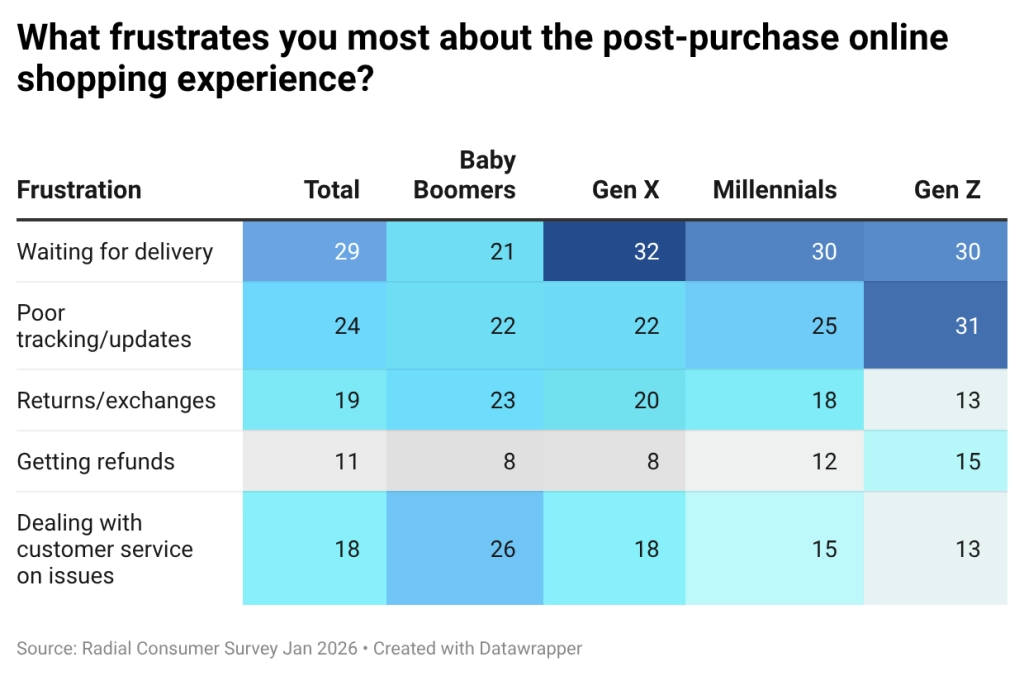
As retailers explore advancements in AI, they can address these frustrations more directly, reinforcing positive experiences and reducing friction in the buying process. But they will also need to balance consumer anxieties and expectations around agentic commerce to build trust.
Retailers Can Design AI Experiences to Deliver Customer Value
Retailers can design AI experiences that deliver real value to shoppers. Just a few of the use cases include:
- Deal Finding: This is the use case shoppers already gravitate toward today. Forty-seven percent of consumers are most interested in maximizing value and discovering deals with AI, making this a good place for brands to start implementing AI recommendations and support.
- Product Curation and Recommendations: While not as tantalizing as finding great deals, shoppers are also open to AI agents choosing replacement items if something is out of stock or supporting them as they decide what to buy for a specific task or goal. Agents can create curated experiences and make targeted recommendations, fostering trust and loyalty with long-term customers. This is an example of what Macy’s recent AI integration does for customers. This use case also supports expanding functionality and rewards within loyalty programs.
- Post-Purchase Processes: Shoppers are generally open to AI support during the post-purchase process. Thirty-six percent of consumers are cautiously interested in AI assistants working directly with stores or delivery systems to order, track, or fix issues. And 33% think such an option would be helpful, saving them time. Fifty-three percent of consumers are somewhat-to-very likely to use AI for monitored delivery and problem-solving. Some brands are already integrating AI into pre-and-post-purchase processes. For example, Tecovas currently leverages AI in their inventory management and allocation process for brick-and-mortar stores.
Each of these uses cases should help brands define the roadmap for how AI can support a strong end-to-end customer experience—all while driving the quality consumers expect to receive.
Shoppers Most Comfortable When Security and Control Emphasized
Shoppers’ trust must be earned by brands if they are to successfully transition to agentic commerce. While a person may trust a retailer and human staff, they may not yet be comfortable trusting an abstract AI agent. When consumers decide to shop with AI, they want enhanced security and transparency, backed by the overriding option to speak to a human employee. Nearly half (46%) of consumers will only be comfortable with AI support if there are strong security or privacy settings. And 42% expect to talk to a human if needed.
Older generations are especially disinterested in working with AI unless there’s a human-to-human option. Fifty-nine percent of Baby Boomers won’t trust an AI agent without a human available, followed by 47% of Gen X consumers. Even younger shoppers want a human to talk to if needed, with 35% of Millennials and 28% of Gen Z indicating it would make them more comfortable with AI agents.
How to Design Agentic Experiences and Boost Customer Trust
If retailers want to implement agentic commerce strategies successfully, they will need to design a transparent, secure process to build trust with customers. When trust grows, shoppers will become more comfortable participating in additional AI use cases, such as supported buying decisions.
Here are ways brands can design the kinds of agentic experiences customers will grow to trust and utilize:
- Establish transparency. Create transparency, security, and accountability for agentic experiences, both from a regulatory perspective and in the context of a consistent, trustworthy customer experience. To complete sales and return for future transactions, customers must feel safe within the agentic commerce experience.
- Anchor on AI accuracy. Nearly one-third of shoppers are worried about incomplete or inaccurate information presented by an AI agent. Brands will need to err on the side of accuracy and transparency to reassure customers that their AI tools can manage the shopping experience effectively. They will also need methods to monitor, report, and repair situations where AI tools promote inaccurate information.
- Foster human control and agency. Shoppers draw the line at losing control and human agency. Thirty-four percent of consumers would limit AI freedom to only actions they approve, while 23% recommend the tool make suggestions only. Only 3% of shoppers are interested in AI taking any action on its own—and only if the results are guaranteed. Brands can most effectively drive AI adoption by providing a sense of control to the consumer, from preference settings to escalation paths involving human representatives.
- Work with experienced technology and payment partners. The right partners can accelerate agentic commerce for modern brands. For example, payment partners can provide a managed payment orchestration (MPO) solution via a payment orchestration platform (POP) to drive operational simplicity and long-term success.
- Work with expert logistics partners. In order to effectively leverage agentic commerce as a competitive advantage, modern brands will need to ensure they have flexible, technology-driven logistics solutions to drive inventory availability, product delivery, and streamlined returns. Future-proofing their logistics will likewise require integrating with cutting edge, AI-driven technologies to ensure agents can converse across protocols and make decisions on behalf of their customers. Many modern brands will need to seek third-party logistics partners to provide flexible, reliable, and AI-oriented distribution and fulfillment on their behalf.
About the author

Discover Radial’s latest research on consumer adoption of agentic commerce.
